Customer experience
The interface must make complex capability understandable and useful.


Wave Genius connects product visibility, technical storytelling, complex buying journeys, operating knowledge, workflow automation and responsible AI around real users and accountable teams.

Technology is experienced as a promise about capability, reliability and change. Growth accelerates when the story, product, evidence and operating reality reinforce one another.
A real operational or customer need defines why the product should exist.
People, data, systems, security and constraints shape a credible design.
Teams translate intent into software, integrations, infrastructure and experience.
Testing, evidence and human review expose gaps before trust is requested.
Controlled deployment, ownership and communication turn a build into a live service.
Monitoring, support, incidents and learning protect real users and business continuity.
Evidence, feedback and strategy guide what changes—and what should remain stable.
The interface must make complex capability understandable and useful.
Research, requirements, documentation and feedback need shared context.
Architecture, data, integrations, security and reliability carry the promise.
Ownership, release control, support and governance determine whether it lasts.

Useful knowledge can move across product, engineering, support and commercial teams without granting every system the same authority.

01Connect category, problem, capability, proof and technical depth to real search intent.
Explore ⟶

02Serve users, buyers, technical evaluators, partners and leadership without flattening the story.
Explore ⟶

03Coordinate content, social, product education and campaigns around credible value.
Explore ⟶

04Prioritize audiences, use cases, positioning, roadmap signals and commercial opportunity.
Explore ⟶
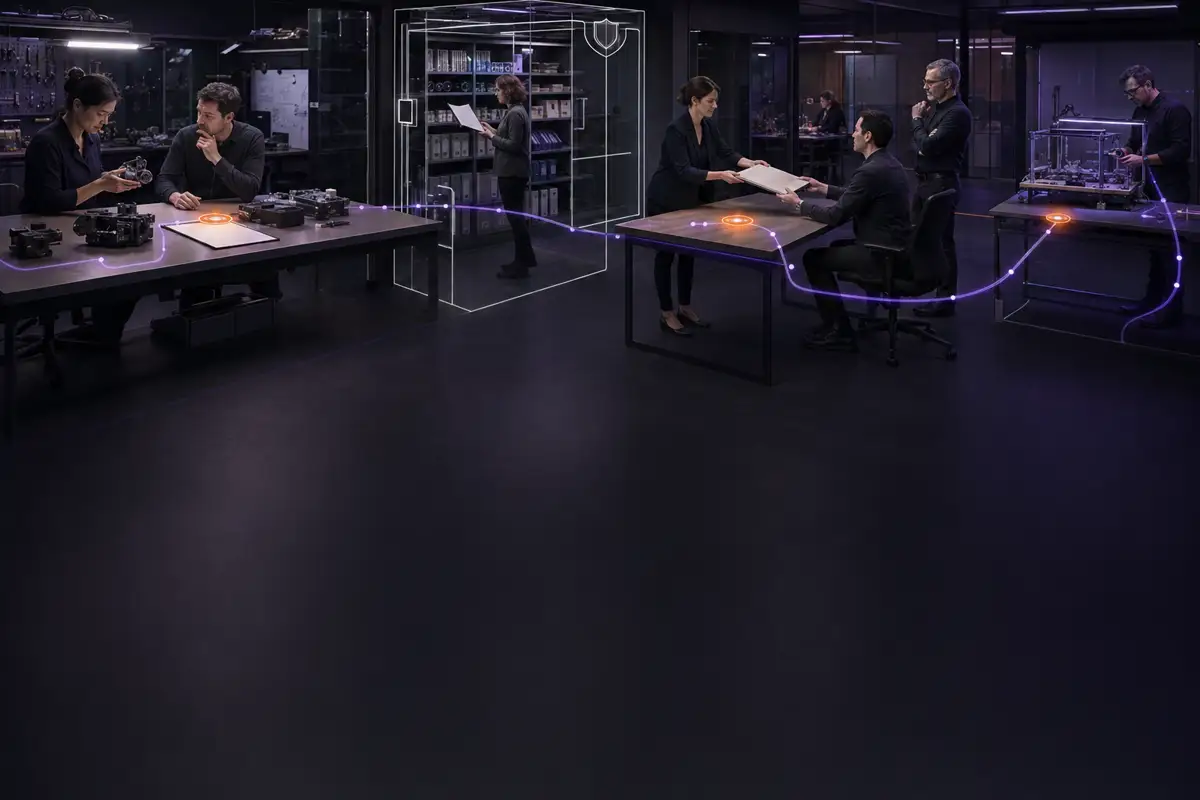
05Support governed knowledge, triage, documentation, coordination and approved automation.
Explore ⟶

06Define sources, permissions, actions, observability, escalation and accountable owners.
Explore ⟶An agent can retrieve approved knowledge, triage routine work and prepare documentation. It must not release production, grant security access, sign off architecture or command an incident.
Explore Custom AI Agents ⟶

Hear users, product, engineering, support, security, sales and leadership.
Trace discovery, evaluation, implementation, release, support and evolution.
Locate weak proof, fragmented knowledge, repeated work and unclear ownership.
Define sources, permissions, actions, monitoring, escalation and success.
Measure usefulness, quality, adoption, reliability and risk before expansion.
The approach can adapt to SaaS, platforms, IT services, cybersecurity, data, cloud, communications, hardware-enabled products and technology consultancies. Strategy changes with product complexity, market and buying motion.
Yes. We layer the journey so business value is clear while technical evaluators can reach credible architecture, integration, security and operating detail.
Yes. We connect discovery, education, evaluation, proof, stakeholder alignment and follow-up around the questions that change across the cycle.
Strong uses include governed knowledge retrieval, triage, documentation, coordination and routine support. Production releases, security authority, architecture sign-off and high-consequence actions remain human-led.
Yes. We map the website, CRM, product analytics, support, documentation, development, identity and integration environments before recommending change.
Measures can include qualified discovery, evaluation depth, product engagement, response time, knowledge reuse, support quality, pipeline progression and controlled adoption.
Tell us where momentum or control is being lost—visibility, evaluation, product knowledge, support, workflows or responsible AI.
Discuss Your Technology Growth ⟶